
For years it was the only question that mattered in Jujutsu Kaisen. The strongest sorcerer alive against the King of Curses. Then it actually happened — and somehow the argument got louder.
That is because there are two questions here, and almost every discussion collapses them into one. Who won the fight is settled. Who is the stronger sorcerer is not, and the reason why comes down to a technique that did not belong to the winner.
This article discusses the outcome of the Gojo vs Sukuna fight in full, including who dies. There is no way to answer the question without it.
Worth being specific: the fight is the manga’s Shinjuku Showdown arc. The anime reaches the Culling Game first, which comes before it. If you are anime-only, this spoils the biggest moment in the series. Come back later.
Gojo vs Sukuna: who is stronger?
Sukuna won. He built an attack that cut the space Gojo stood in rather than trying to cross it, and Infinity has no defence against that. Canon, settled, not a debate.
Was he stronger? Probably not. He won with the Ten Shadows and Mahoraga — techniques that are not his. They came with Megumi’s body. Without them there is no adaptation, and without the adaptation there is no answer to Infinity at all.
Which is why the argument survives the result. The fight is decided. The question is not.
- Categories Judged
- 10
- Gojo Takes
- 4
- Sukuna Takes
- 5
- Drawn
- 1
The two fighters

Satoru Gojo
Absolute talent, born with both halves of the answer
The Six Eyes and Limitless had not appeared in the same person for centuries. Gojo got both, and the combination does not merely make him strong — it makes him efficient, which is why he could fight all day on cursed energy that would leave anyone else empty.
- Limitless / Infinity — A permanent convergence of space in front of him. Anything travelling towards him halves its remaining distance forever and never arrives.
- Six Eyes — Perfect perception of cursed energy, and the efficiency to run Limitless continuously at almost no cost.
- Blue, Red, Hollow Purple — Attraction, repulsion, and the imaginary mass produced by colliding them. Purple does not damage what it touches; it deletes it.
- Unlimited Void — A domain that inflicts infinite information. The target stays conscious and completely unable to act.
- Reverse Cursed Technique — Heals his own injuries mid-fight, including wounds that should have ended it.
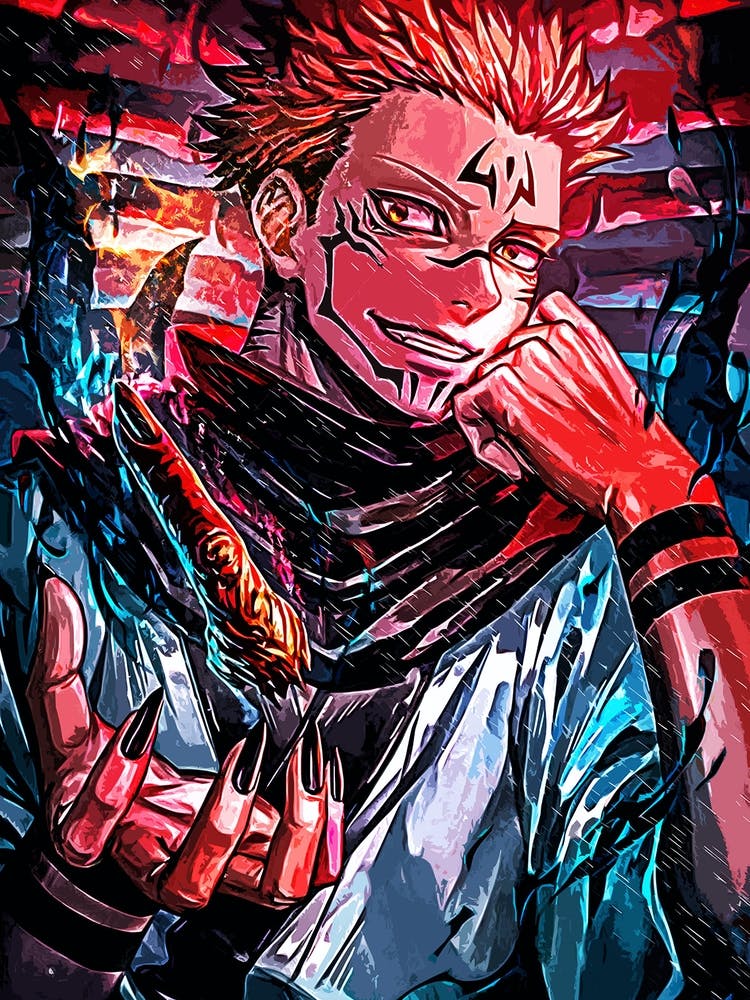
Ryomen Sukuna
A thousand years of mastery, in a borrowed body
Sukuna is not simply a larger reservoir of cursed energy. He is the most complete technical jujutsu practitioner in the series — barriers, binding vows, domain construction, reverse cursed technique. He understands the rules well enough to find the exceptions.
- Dismantle and Cleave — Slashes tuned to the target. Cleave adjusts to durability, Dismantle cuts everything in a plane. Both are cheap enough to spam.
- Malevolent Shrine — A domain with no enclosing barrier — enormous range, permanent uptime, and constant automatic slashing across everything inside it.
- Ten Shadows Technique — Not his. Taken with Megumi’s body, and the single most important factor in the outcome.
- Mahoraga — The shikigami that adapts to any phenomenon given enough exposure. The tool that eventually solved Infinity.
- Combat intelligence — He does not try to win exchanges. He spends them buying information, and he is patient enough to lose for a long time first.
The five things that decided it
How Sukuna actually beat Infinity
Not by hitting harder. By changing what he was aiming at.
Infinity converges the space between Sukuna and Gojo, so every attack aimed AT Gojo decelerates forever and never lands. Overpowering it is not a strategy, because there is no amount of force that shortens an infinite distance. Mahoraga’s adaptation gave Sukuna the model for a different question: rather than sending an attack through that space, cut the space itself. The World-Cutting Slash targets the world Gojo occupies instead of Gojo, and Infinity has no answer to that because it was never designed to defend the ground. That is the whole fight. Every exchange before it was Sukuna paying for the information.
The domains were genuinely even
The most misread part of the battle.
Unlimited Void is the more devastating effect — a guaranteed hit that shuts down the target completely. Malevolent Shrine is the better instrument: no enclosing barrier means enormous range, and it stays open, cutting continuously, without Sukuna needing to maintain a sealed space. When they collided neither simply won, and the exchanges cost both of them enormously. Anyone claiming one domain plainly beats the other is describing a fight that did not happen.
Defence was never the problem
Gojo has the best defensive technique in the series and it is not close.
Before the World-Cutting Slash, Sukuna had no way through. Everything he had — Dismantle, Cleave, physical strikes, the shrine’s automatic slashing — had to cross the converging space, and none of it arrived. Add Reverse Cursed Technique and Gojo could undo whatever did get through. This category is Gojo’s outright, which is exactly why the fight took as long as it did and why Sukuna had to solve a problem rather than win a brawl.
Sukuna won on patience, not power
He was losing exchanges deliberately.
Gojo was visibly ahead for long stretches, and a lot of the argument about this fight comes from people who stopped watching there. But Sukuna was not trying to win those moments — he was feeding Mahoraga exposure to Infinity and waiting for the adaptation to complete. Winning individual exchanges is not the same as winning a battle. Gojo fought to beat Sukuna; Sukuna fought to understand Gojo. Only one of those needs to work once.
The tool was borrowed
And this is where the settled fight becomes an open question.
The Ten Shadows Technique is not Sukuna’s. Mahoraga is not Sukuna’s. Both came with Megumi’s body, and without them there is no adaptation, no model for cutting space, and therefore no answer to Infinity. You can argue that taking Megumi was itself an exercise of Sukuna’s superiority and the tool counts. You can equally argue the strongest sorcerer lost to a technique his opponent did not own. Both readings are defensible, and the series never adjudicates it.
Category breakdown
| Category | Edge |
|---|---|
| Defensive technique | Gojo |
| Speed and reflexes | Gojo |
| Perception | Gojo |
| Hand-to-hand combat | Gojo |
| Raw cursed energy | Sukuna |
| Offensive arsenal | Sukuna |
| Combat intelligence | Sukuna |
| Adaptability | Sukuna |
| Regeneration | Sukuna |
| Domain expansion | Tie |
Five to four with one drawn — and note what Sukuna’s column has in common. Energy, arsenal, intelligence, adaptability, regeneration are all about outlasting a problem. Gojo’s are all about not having one. That is why the fight lasted so long and why it ended the way it did.
The rematch nobody gets
Take the Ten Shadows out and run it again. Sukuna keeps Malevolent Shrine, Dismantle, Cleave, reverse cursed technique, a thousand years of technical mastery and cursed energy reserves Gojo cannot match. He is still, by a distance, the most dangerous curse in the series.
And he still cannot reach him. Every one of those tools has to cross converging space, and none of them does. Without Mahoraga feeding him a model for attacking the world instead of the man, Sukuna is left doing what he did for most of the actual fight — paying for information he now has no way to use. Gojo takes that version, and it is not especially close.
Settle it yourself
Canon says Sukuna. But the question this article is actually about — who was the stronger sorcerer — is still open. Cast a vote, then argue about it in the comments.
Why this fight is the series
It was never strongest versus strongest. Gojo is talent — born with the Six Eyes and Limitless, a combination that had not occurred in centuries, and he never had to work out what to do with a problem because he never had one. Sukuna is mastery: a thousand years of understanding jujutsu deeply enough to find the exception in every rule.
So the ending is thematically exact. The man who was never given a problem lost to the man who had spent a millennium learning how to solve them — and even then, only by borrowing a technique from a child. That is a better answer than a power level, and it is the reason people are still arguing.
Frequently asked questions
Who won, Gojo or Sukuna?
Sukuna. That part is canon and not open to debate — he developed an attack that bypassed Infinity by cutting space rather than crossing it, and Gojo did not survive it.
Was Sukuna actually stronger than Gojo?
Different question, and a genuinely open one. Sukuna won using the Ten Shadows and Mahoraga, neither of which is his technique — both came with Megumi’s body. Strip those and he has no route through Infinity at all. Whether a borrowed tool counts is the real argument.
Could Gojo beat Sukuna without Mahoraga?
Most likely, and the fight itself is the evidence. Sukuna spent the entire battle unable to reach him and had to solve a problem instead of winning a fight. Remove the adaptation and that problem stays unsolved.
Is Malevolent Shrine stronger than Unlimited Void?
Neither dominated. Unlimited Void has the more decisive effect; Malevolent Shrine has vastly better range and needs no enclosing barrier. Their clashes cost both sorcerers heavily, which is the honest read.
Has the Gojo vs Sukuna fight been animated?
It is the manga’s Shinjuku Showdown arc. The anime adaptation reaches the Culling Game first, which comes before it — so if you are anime-only, this article spoils the single biggest moment in the series.
Keep arguing
More matchups: Infinite Void vs Malevolent Shrine, Gojo Satoru vs Prime Whitebeard, and the 50 strongest anime characters ranked.
Does the borrowed technique count?
That is the whole argument. If taking Megumi was itself proof of superiority, Sukuna is simply stronger. If the strongest sorcerer lost to a technique his opponent did not own, it is a different answer entirely. Tell us which side you are on.